Assessment and Evaluation
What role might assessment and evaluation play in your classroom? In teaching, generally?
Consider offering an example of an assessment or evaluation you’d like to give, or that you witnessed in your placement and analyze its worthiness based on the criteria we discuss in class and/or your own criteria.
Assessments are often one of student’s least favorite part of education. The often rely heavily on memorization and, with the increasing focus on standardized testing, often cause a disproportionate amount of stress on students due to how much they can determine your grade for a class. However, assessments and evaluations should be a way to for both teachers and students to assess how much has been learned in the class and what might be improved. Assessments, “at its best, provides us as teachers with important knowledge of students and their growth as learners, informs our ongoing curricular and pedagogical practice, is a basis for helping students reflect on their own learning, and serves as a window for parents into the power of the teaching-learning exchange involving their sons and daughters” (Perrone, 130). “At their best, classroom assessment practices are fair, seen as opportunities for success, are more than one thing, encourage self evaluation, and inform instruction” (Perrone, 130-131). With this in mind, how can assessments both evaluate where students are in the class and provide motivations for continued learning? The answer to this depends on what goals educators have for student learning and how educators best believe those goals can be reached.
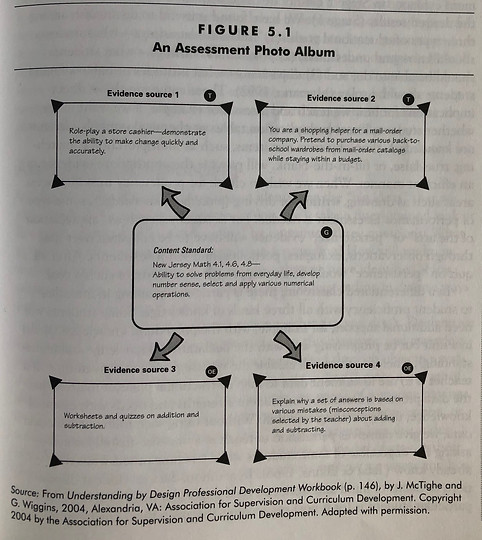
The Understanding by Design model “distinguish[es] among three types of educational goals: (1) declarative knowledge - what students should know and understand, (2) procedural knowledge - what students should be able to do, and (3) dispositions - what attitudes or habits of mind students should display (Marzano, 1992)” (Tomlinson & McTighe, 64). These goals in turn have different types of assessment to evaluate where students are in these learning goals. “Diagnostic assessments (or pre-assessments) typically precede instruction and are used to check students’ prior knowledge and skill levels and identify misconceptions, interests, or learning style references” (Tomlinson & McTighe, 71). These may be especially helpful for figuring out starting points for students and finding pathways of engagement for particular students. “Formative assessments occur concurrently with instruction… [and] provide information to guide teaching and learning for improving achievement” and “summative assessments are generally used to summarize what has been learned” (Tomlinson & McTighe, 71). These are the assessments that students are most used to in the form of test and quizzes. However, test and quizzes are often so high stress in part because they rely more heavily on memorization of content and often do not have meaningful ways for students to apply content. While this does not mean that tests and quizzes are not meaningful forms of assessment, it does mean that they should not be the only form of assessment. Educators should also utilize other forms of assessment through projects, presentations, or other work in other mediums as a way to evaluate student understanding of the content. “Alternative or authentic assessment is a way to evaluate student performance other than by traditional testing (observation and conferences). It does not lend itself to comparing or ranking students the way standardized testing does. Instead, alternative assessments seeks to determine not only what students know but also what they can do. Proponents argue that such assessment is more aligned with ‘real-life’ practice, reduces competition for grades, and helps students become proficient judges of their own efforts” (Orlich et al., 2001, 364). With this option for differentiated assessment in mind, it allows student more pathways to success and opportunities to demonstrate the skills that they have learned more informally in the class such as communication, oral presentation, etc. Various forms of assessment would also more easily incorporate different learning preferences and better takes into account the intelligences students bring from their different cultural contexts, allowing students from non-dominant cultures to also achieve at higher levels (Sternberg, 2007, 148). With this in mind, especially for summative assessments, a tic-tac-toe menu of options for students allow students the greatest opportunity for success and investment in their final projects because they have more creative choice in deciding what they want it to look like (See Image 2). Furthermore, because of the use of multiple forms of assessment through this method, educators are able to get a greater picture of what students have learned through multiple assessment tools rather than one final unit test that often only allows students who are good test takers to succeed (See Image 1).
My placements have provided many forms of assessment depending on the subject. One form of assessment that my student dialogue partner had to do for her English class was create an Instagram for someone from the literature they were reading. This project allows for student choice which allows the assessment to be made meaningful by the student. It also evaluates student’s use of social media as a medium to convey important information and knowledge, which is a skill that they will need beyond the class. In relation to the content, being able to complete the project relies heavily on whether students understand the text well enough to find appropriate ways to convey the information. Assessment like these can be very helpful for students to not only utilize multiple skills in a format different from traditional forms of testing, but it also looks at how the learning in the class can align with real life practices and be presented in meaningful ways that promote further learning.